✦
My friend held an estate at the border, distant and remote. In his letter he informed me of a means to enrich ourselves as we had before. Reading between the lines of course.
I went to him, I, Faience the knight, the darehander, agent of INNOCENT, loyal servant to the church and my lady whose saint day was not long past, the lady of the true heart. I have no memory of my passage. There was only the moment I held his letter, and the moment I arrived.
Evening bled across a courtyard of autumn leaves, renewing them like dried blood made fresh. His mansion was flooded with abundant carpet, a sign of his rising fortunes. As soon as I thought I had mapped the entrancing pattern, the textile presented a new corner of its maze. It seemed at once as uniform as the forest canopy, and as various. A sea of trees that becomes, on close inspection: rotting leaves, dung, spoor, mold, sun-smoked carcass, rat skulls in spiderwebs, all the uncomfortable debris of nature. Dried mucus. Hairs in carpet. I so detested filth. Was that my fateful juncture? The need to keep my silks white, my reputation without stain?
I was summoned to dine with my friend the viscount, the vicomte, vice comes, my companion in vice. I hardly deserved to be punished for this. For those small pleasures others would have taken if I had not. And mine more expensive and secret than others. Who should bear the burden of that tax? A great virtue is a great strain.
But my friend’s famous good humor was nowhere to be seen that evening. This great well-formed knight was somber as those saints that judge you from mosaic walls. His wife was nettled and distracted. For many reasons I would not marry, and this was another reminder to continue as I was, unsnared by bonds and contracts. His son was the only one who retained a ready smile, though perhaps too stiff and confused at times. But that was normal of boys his age.
Despite this, my friend’s court was colorful as ever. The dishes were well seasoned and made my nose run, a welcome change from the dull cuisine of the mainland. An emissary from the xrafstar was there, and I deduced this was the man who would improve me with silver, obliquely mentioned in my friend’s letter. Naturally, I found any slave of the insects to be repulsive. He was pale and sickly, but flushed with drink, stinking of sweat he could not cover even with the most atrocious jasmine perfume. Yellow teeth, but perfect. They must have been replaced. A dead and oily mouth, which brought polite laughter whenever he spoke but said nothing worth remembering. He fit perfectly my perception of the languid, incontinent grovelers of that cursed empire.
His terms, however, were favorable. The viscount and I took our share, which was only right, wasn’t it? They wanted merely to sail their ships through some forgettable passage, and what those vessels contained was written on manifests that would be unfolded, read, and signed to save the trouble of inspecting the holds they described. Grain. Horses. Spices. A palace vintage such as he shared so generously with us, and other gifts I took to bed, setting aside my rapier so the lady on the pommel could not regard me. It was too much like the prow of a ship, and the sounds made in that bed, too much like the hold of one.
His gift came generously adorned with a silver mask, from which long golden hair poured over smooth skin, so I could tell myself they were a woman, and I still a man. They made no sound. Even pleasure did not escape their lips, though they were very skilled at it. Why did I long to pull back that silver mask? For the very reason I could not.
A soothing oil that eliminated all friction, leaving only pleasure in so pure a form that all else was driven from my mind. Their sinuous body gyrated, hip and belly swimming in and out of the yellow moonlight, until with violent pressure I burst up into them, with such force my teeth ached.
I despised the filth of this act and always bathed afterwards. But not tonight. I was drained as the bottle in my fist, wonderfully tired and drunk, suffused with that pleasant and reclusive warmth that signals you are on the edge of sleep, just about to tip inside…
I saw bodies breathing in the dark. Chained to walls. Packed together like the hot embrace of my lover, glued by sweat.
It was still dark when I woke. The gifts were gone, leaving only a bed smelling of sin and a bottle turned to broken glass on the floor, in a room made strange by darkness. Only after laying there a few minutes did I realize what had woken me. Those sounds which seemed ordinary coming from the dark jungle, now became unsettling as I placed them down the hall. Sounds too much like those made at the point of climax, but with no pleasure in them. I followed them to the dining hall, which was now a great black cave with only a hungry orange fire at the end of it, and too much smoke, the wood too young and green.
The viscount’s wife sat naked at the table. Her face streamed with kohl, clammy-red and sobbing, as she sawed her nipple with a small knife, a letter opener or fruit peeler, until it dangled like a piece of salami.
I looked to her husband to protect her, but the viscount knelt before the fire, his frame shaking with what I came to understand as resistance. He had been cut all over, and suffered other indignities I would sooner not describe. At the worst rout on campaign I had not seen him so afflicted.
The sickly man watched it all. I saw now this sickness was a sign of great health, and that he was no emissary. He was the prince of the xrafstar, his cheeks flushed not with wine, but fever.
I said something like: “Why?”
From the babbling of the viscountess I derived the prince had asked to spend the night with their son, and this was the product of their refusal. But perhaps it would have happened anyways, in the end. That look on his face was boredom. The bone-deep boredom of eternity. A boredom that turns to horror and panic in the chest if you let it bloom. We were his wet ink. A series of images to amuse him.
I tried to tear myself from this scene, but he told me to be still. So I was.
He commanded the viscount to put his head in the fire. The shaking became violent and I thought surely now his hold would be broken. But then those strong limbs dragged forward and the hair began to smolder and have you ever let a cut of meat sit too long on the skewer? Could you lay your head down as gently upon a bonfire as your soft pillow?
My friend was no longer silent, but I listened in vain for his former charm, or the presence that dominated a tactician’s tent. He screamed until lips and nose melted together. The noble limbs kicked behind like a horse, yet still could not break the command. Even when fire had revealed the tonsure of the skull, he remained on all-fours, obedient as a dog. If only dry wood had filled that fire, not smooth green saplings.
Finally he moved no more. During this display I felt an ebbing of attention, and had been able to force my feet along the carpet, though with such tension it burnt my skin. I ripped the knife away from the viscountess and her tongue bled onto the tablecloth, sliced halfway through. Her fingers crawled up into her mouth like spiders, and her long lovely nails, so oft remarked upon, now began digging, even as she moaned with the organ she was destroying. I seized her hands, but she brought her head down to continue the work, magnetized to her task. I shouted at the prince to stop. With my friend gone, it was the least of my honor to protect what he loved—
“Your honor?” came his lazy murmur. “That forfeit thing?”
From his dark corner he saw into me like clear water. Had I no complication in my history? Was I so diluted?
“Your friend brought me close. Out of greed.” His voice was a dead slug in the mouth. His voice was sand that retained the heat of the sun after it hissed out on the horizon. The hairs on my skin were like the hairs of the inner ear, conducting him all over me. “You shared his greed. And now you are sick as well.”
His antennae became apparent against the flickering shadows, dancing in eerie contrast to his lifeless drone. “For greed. For lust. For ambition. You have found yourself in this room. Standing right there,” he said, as if I were being posed for a portrait. “By the firelight.”
The firelight, from which was subtracted the shadow of my friend, who blocked the fireplace like an acephalic hound trotting into hell’s mouth. A mouth-watering smoke coated the room and my nostrils.
“A fly buzzing around a torch. Too stupid to know the doom it regards.”
His command to be silent did not prevent an unsettling respiration. He had not ordered them to stop breathing, and so necessary breaths strained at the very edges of distress. I cannot communicate what those almost-words were, the low moans of the throat you might imagine whilst walking late night through a cemetery. But with my friend face down in the fire, only his wife remained, and it seemed almost too much for one body to produce, even accounting for the viscountess having nearly succeeded in freeing her left eye, if not herself. She had to make do with her fingernails for the rest of her chores, since I had deprived her of the small knife. Her eye hung from a stalk, the twisting nerve making a sound like cherries being picked.
And still that near-moaning continued, like some ailing cat under the table. It did not quite match her, notwithstanding her ventriloquist’s constraints. There was someone else in the room with us.
Only then did I notice their son in the corner, all the way back in the darkness. No mark upon him, his only command to watch in silence. Snot glistened on his face, and I thought of drowned children laid on a table after washing up on the banks of the May’ Soror, so their parents might have a chance to identify them. Pagans said the children should be left in the water so they would live on in the mud-kingdoms, sodden pages for whatever ruled down there.
“Down on your knees.” Everyone trembled to hear that voice. Awaiting the word or glance that would confirm they were the recipient of that siege-hot oil dripping in the skull. Have you had a greased finger twisted in your ear? When you were otherwise calm and unaroused and a brush of your soft lobe could set a tingle down your whole spine? It was that. But pressed far too deep, crackling like waxy water in the ears, pushing between the other, greater lobes, splitting your seat of reason like a slimy cut of pork.
The viscountess, nipple still dangling—her remaining eye oozing from the excavations of her nails—dropped from her chair to the floor. There had been no command to rise first, or smooth out the skirt she did not have, or account for the transitioning of joint and muscle. She dropped like a marionette to the floor, then spread into the same position as her charred husband. I thought he would order her into the fire as well, and I shuddered at how faint the flame had become, which could not have browned a small roast all the way through. But instead, he turned to the boy. “Fuck her.”
Of course I tried to stop it, flinging myself at him in another lapse of his attention. And of course he stopped me. The command in my skull was like a torch to tallow. Rashes burst upon my skin, scarlet echoes of his words, transcribed by fire ants. But I could not scratch, so they lay like drops of acid on my flesh. I could not have shaken them off, even if they melted all the way through me.
The boy was too young to perform the necessary act. That was one thing the prince could not command. So he gave the boy a needle or rod of some kind, I could not see it closely. A pen? Something firm to keep his organ erect, thin enough to go inside, but tearing, bleeding, and still that awful command to make no sound. But I could. I alone had the use of my tongue.
“Fight me!”
His bloodshot eyes regarded me, two rosy dusks captured in marbles.
I spoke quickly, knowing his next words could end mine. “Or are you afraid?”
With contempt he said, “Be free, darehander.” I could move again, and drew too quick and desperate my rapier, like one who, freed from a nightmare, spasms in their bed. He had a blade of his own, fearfully tarnished and ugly, somewhat shorter but thicker than mine. Damascened silver disappeared into corrosion like waterspouts above a murky ocean. That ugly rust should have been my intimation of his century. We circled the carpet, my bare feet sinking into the thick shag. I shook the stiffness from my hand, whirling my slender blade through the air to make myself braver.
It was uncanny to face him, stances blurring through his limbs. Like fighting many men in one, a mad procession of duelists and executioners and cutthroats, interrupted here and there by hounds and bears. But for all his experience, he lacked the focus of mortality. Only one of us could die.
His style at first reminded me of the archaic lessons of my first fencing instructor, a scarred relic of the last century. Then came hints of the archipelagic school, for those fighting on a swaying deck—it made me seasick. And finally the lazy arc of his swings revealed nothing so much as boredom. Swatting me away like a fly. I am no fly! You are the insect!
I threw my body against him, succumbing to his savagery. He tripped on the carpet and reeled back, I lunged, I cornered him against the table littered with wifeflesh and there my rapier pierced his breast and I felt the exultance, the relief of victory—
“That is a pretty laugh,” he said, and the calm in his voice appalled me. He stared down at the slender length of steel lodged in his chest. “The fool duels a heartless man.” His blade sank into my thigh, then pulled upwards, ripping out a great spurt of blood, of me.
A cold shadow rose up to the ceiling and drove me back. A violent sweat blinded me, my grip became slippery, my rapier strange and soft in my hand, bending against his uncaring bone, ensnared in veins which grew back like vines, puncturing arteries which sucked back their contents, and I knew then my faithful sword was no protection. But still I thrust desperately, my poise and training gone. I might as well have used my teeth. As he did.
When he broke the skin of my hand, it was hot venom and fever, my veins burnt up like dry cord and my heart the gunpowder. Mucus burst from my nose, blood from my eyes, my ears—my clothes were crimson-soaked as if massacred from every angle, he needed no blade to bleed me. But he used it anyways, with the relish of a butcher. He slashed—no, he pared me. Cut my fingers away, leaving one dangling pinky for a teacup. My lips could not close and I cried at my ruined body, knowing that even victory would no longer save me. But still I tried to live, crawling across the carpet which drunk at me with his greasy hungry hair or was it just a carpet? The bottle had broken on the floor, I remember this now. How could it have broken on this soft, soft carpet? I tried to crawl back into bed, that warm bed which had seemed so much like the hold of a ship, but I floundered in a cold ocean of glass.
Then came a wet peace that I suppose comes to men in the end, which one admires in others, in stories, but thinks will never come to them. To accept this terrible end seemed all that remained to me, my last gasp at honor being this: to die well. I tried not to tremble as I lifted my head, as the blood in my face pulled toward him, aching in my eyes. I spoke as if the audience to my accolade was there, I heard their cries, I felt petals falling from the sun.
“I will die a hero. My martyrdom will inspire all of the true religion to take up arms against you.”
At last those yellow teeth spread, finally I had amused him! “You shall have no legacy. For you shall not die.”
He sat upon me like an alp, those dirty nails creeping up my chest. The jasmine was no perfume, it was of his ceaselessly sweating flesh, such hot summer rains, each drop igniting my skin, leaving rashes ugly as burns. And he—
I recall enough of my etymology—contaminate. To touch. Yes.
Infect, to put something into. Yes.
✦
Every time I woke, the carpet was at my back. Sometimes my belly. Abrading my skin, except where my blood sopped it like a puddle.
And then a darkness came which seemed truer than the others. As I fell, I thanked my lady for this mercy, though I lacked the tongue or the fingers to properly do so. Thank you for ending my pathetic existence.
I woke up nailed to a chair. Memory blooms in that dark slope of my tailbone, in the valley of my shoulder blades. I’ve seen it in a thousand chairs of every size and shape, in the heart and hue of every tree, big and rough, smooth and slender, brown and crimson and ivory. Was it the boy’s chair? Was it small and I was being taught a lesson? Hands and feet nailed down, such a small chair would have bent my back until I was almost disappearing into myself. At least the boy had escaped. I hope he dragged his mother from that room. I hope they went far.
Yet that small piece of honor was taken from me as the prince worked upon my body. For if I had been returned to the start of that night, to the threshold of the dining hall, knowing what I did now—I would have turned and ran. I had not been brave, I had thought I would be rewarded. I cursed the boy, I hated him, and if he had been presented to me, I would have killed him myself. I would have done anything.
“Here is the rule of our game. Listen carefully.”
Yes, yes!
“The rule is. Keep smiling. No matter what.”
I don’t understand—
“I want to see what kind of smile you have. The ring of your laugh. Your…humor.” And here his fingernail pressed upon a throbbing artery. “These are all reasonable considerations.”
A chime of metal objects in my blind spot (that was soon to grow), tingling at my ear, dancing cold down my spine—
“So. No matter what. Keep smiling.” And for the first time, he was almost gentle. Gentle as the guillotine supporting your neck. “When you live forever. It is important to retain your smile.”
I could no longer beg for death. That brief vainglory had fled, leaving only violent terror. I wanted to live!
“Are you worthy of being cast upon the ocean of eternity? Can you amuse me?”
At some point my teeth cracked. Through what remained of my vision, his pale form became striped with red. A lull came, but my muscles were knots drawn so tight it seemed they would never again be undone. I shook in place, waiting for his next torment, which arrived always from his intuition of my own thoughts, his comprehension of what I absolutely could not bear, of the next thing I could not live without, and the next thing, and the next—
He came close and I flinched, but he was only setting his tool down. No part of my body had not been altered by him. The only constant was that in the ruin of my mouth, there was still something like a smile. He had left teeth enough for that, and parted those pink drapes which may sometimes obscure except in ossuaries such good cheer as we all possess.
He turned to leave. “You can die now.”
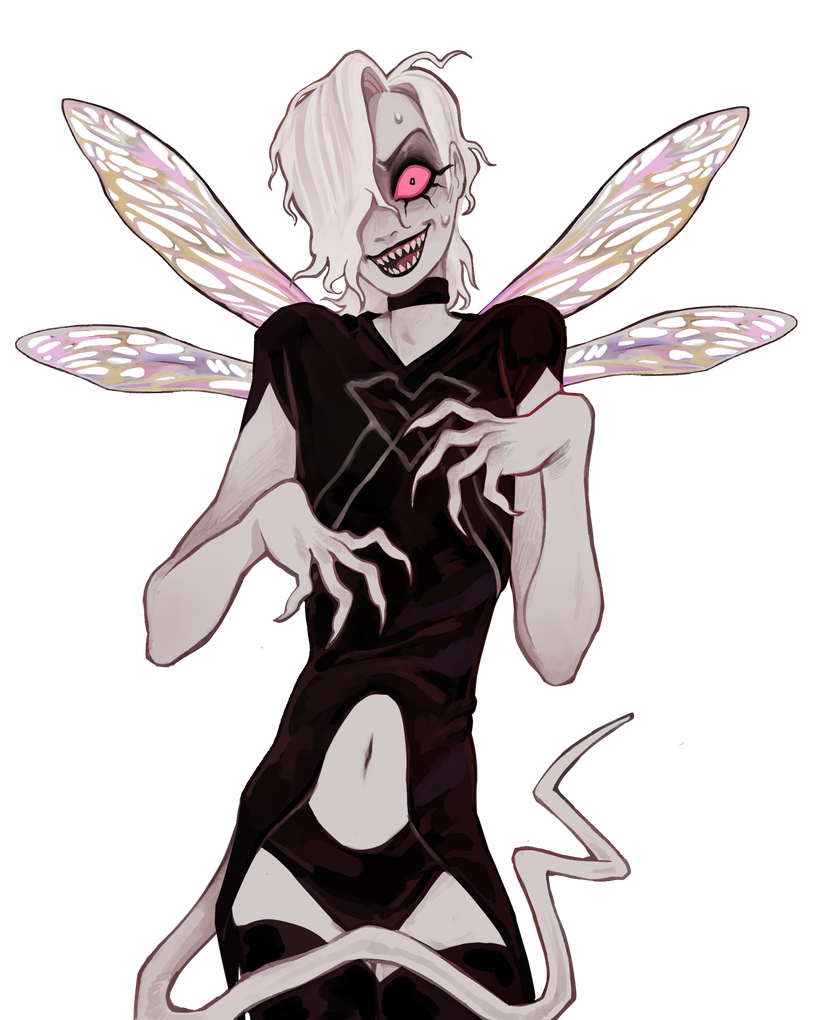
That was the moment when I begged him. Begged him for the disgusting plague in his veins. I whined like a dog as he nursed me with his saliva. His humors. Everything that came from his body. Sewing my lips up with spit so that I could thank him with every sob. Until just enough hair had grown for him to pull back my head and show me—what lifelike painting was this? What cracked mirror? I did not recognize this face. Hair pale as the cadaverous skin. Eyes pink with a mist of blood. Teeth grown yellow. I wept anew at the sight, was this me?
And to know this: every scrap of flesh that grew back was his. Nurtured by his disease. Immured by my veins, head throbbing with fever that would never break as he had broken me.
“Now that you can no longer die. I can teach you properly.”
But not in that hovel of a mansion. Only his palace could adequately echo with the sounds that were to come, an auditorium designed for the most exquisite eruptions of the throat. And so he taught me for the first time how to sleep, by cupping my head with his hands and staring into my beaten, fawning eyes. Then came a harsh crack and the room spun wildly. It was the snap of my cervical spine, vertebrae like glass shards cascading down my back; with a single movement he broke my neck, twisting it all the way around, and I must have seen then the color of the chair, if I could just see it, I might finally see—!
✦
I woke in a stinking blackness. My neck had just pulled itself back into alignment with my spine, nerves nibbling my brain awake. But the room did not cease its swaying, even then. I gagged on rotten salt, an enveloping odor like waking up in the fetid depths of a guano cave, humidity clinging in the absence of clothes.
Somehow I could see in the dark. I was chained to the wall, my back scraped by rough timber with each tilt of the room. The manacles did not cuff my wrists, my neck, my ankles. They pierced them. I could not tear the steel out, for my greedy flesh sucked it tight. My very tears were a foul reminder of this stain, as in the darkness bloomed that suffocating fragrance of jasmine, his perfume trickling down my cheeks.
Around me were statues and paintings and mounds of xeraphim, a grim vault of his rape and plunder. I saw the money best of all. Even in the pitch black its peculiar luster penetrated my eyes, an oleaginous shine I would come to recognize as the grime of unclean fingers. The coins rattled under my naked flesh, this hard lucre my only bed. I lay with all his other prizes, held fast in his dark hold.
✦
✦
Thank you Thecla for your superb edits. They are always so thoughtful, and this story was transformed by them! <3
And Vich for your delicious art, from our delicious game that hopefully everyone will get to see this year…
Ohhhhh…. this felt so different from your usual writing, I mean that in a wholly complimentary way…
I could imagine someone reading this to me in the dark, their lustruous voice peacefully describing the torture, the atrocities… excellent work, thank you <3
appreciate that, it was so fun getting into his mind. lustrous torture asmr, yes….thank you for reading <33
Wow that was horrible
thank you!
Wondering, how long has INNOCENT existed for? how long has even this world existed? Was there a time before humanity, when xrafstar would perhaps appear less humanlike? Were there gigantic xrafstar in the carboniferous period, if there was such a period? Or is xrafstar existence dependant on human existence? many questions form in this grey mush, most probably already answered, unfortunately i am not well read.
Also, that was a nice story, felt easy to visualise the contents.
Did he end up becoming another of the xrafstar’s little masked gifts?
I read this way back, but life got in the way of reviewing. This is precisely what I’m after. Never stop with these offerings from the Cancer extended universe.
Also, a question. Since the Cancerverse has this recurring theme of characters being named after porcelain (or porcelain-adjacent materials, like faience)… was it intentional that Riparian’s name contains “Parian”, as in Parian ware?
That’s by the by, I can’t overstate how much I love this particular story.